Authored By: Michael Sassano and Antonio Guedelha
 No matter what you build or which equipment you purchase, your business cannot be successful without hiring key staff positions and employing knowledgeable personnel. As discussed in the previous installment, almost every step in the Good Manufacturing Practices (GMP) process requires the input and approvals of competent, qualified personnel who can deliver. As you grow, your company will layer in multiple levels and supporting personnel. It is important to consider your structure ahead of time as you build up the areas of function and zero in on the recruitment process.
Corporate Structure
When your company is small, the personnel structure organization needs to be simple, yet efficient. One experienced general manager who works with a qualified person can easily manage the various functions that drive a GMP-compliant manufacturing facility. A very flat structure with few levels of hierarchy creates an environment that allows for quick decision-making and steady advancement. The most common starting structures can be seen in the chart below.
 As time goes on and your company grows, layers begin to form under these starting blocks, spreading managers throughout the different sectors to monitor the various processes and procedures. The two main groups employees pertinent to the GMP process fall under are Quality Assurance (QA) and Quality Control (QC), or Production.
Quality Assurance
The QA Team is tasked with ensuring all areas follow all the necessary procedures and standard operating practices (SOPs) and check each step of the manufacturing process. Ensuring the integrity of the process as well as the quality of the products is what regulators desire to see in order to maintain a high degree of confidence. In larger companies, the Quality Team/Unit is usually headed by a Qualified Person (QP) whose job is to hire Quality Assurance Manager, Laboratory Control Manager, and Head of Regulatory Affairs.
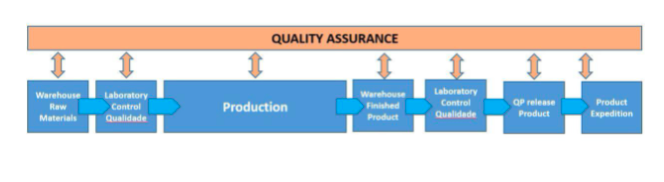 The manufacturing process begins with reception and storage of raw materials in the warehouse. Each delivery is then sampled and tested by the Laboratory of Control. The Lab Technician will analyze and approve or reject the raw materials which are received. When the materials are approved, the production teams then develop them into finished products. Meanwhile, the QA team will monitor the process and conform both in-process and results at each step. Laboratory Control takes samples to analyze and either approve or refuse. After the finished product is verified by the QA team, the product is then stored in the warehouse. Finally, the QP releases the product to the market and logistics will send to the clients.
Quality Assurance is independent of the operational execution of manufacturing. The QA can do their work without bias to the production stresses to make sure the correct process is always followed and the results are verified. The guiding mission of Quality Assurance is to verify and assure each step of finished product manufacturing is completed and recorded correctly, according to GMP, SOPs, and manufacturing instructions.
The manufacturing process begins with reception and storage of raw materials in the warehouse. Each delivery is then sampled and tested by the Laboratory of Control. The Lab Technician will analyze and approve or reject the raw materials which are received. When the materials are approved, the production teams then develop them into finished products. Meanwhile, the QA team will monitor the process and conform both in-process and results at each step. Laboratory Control takes samples to analyze and either approve or refuse. After the finished product is verified by the QA team, the product is then stored in the warehouse. Finally, the QP releases the product to the market and logistics will send to the clients.
Quality Assurance is independent of the operational execution of manufacturing. The QA can do their work without bias to the production stresses to make sure the correct process is always followed and the results are verified. The guiding mission of Quality Assurance is to verify and assure each step of finished product manufacturing is completed and recorded correctly, according to GMP, SOPs, and manufacturing instructions.
Qualified Person
The head of QA can be the Qualified Person (QP). In some countries of the European Union, the QP must be a Technical Director with a Master in Pharmacy and an additional noteworthy title of Specialist in Pharmaceutical Industry. The QP is responsible for all problems that may arise from the use of the products. So, only they are allowed to release the finished product to the market.
Laboratory of Quality Control
Laboratory of Quality Control (LQC) is monitoring all materials, intermediate products, finished products and utilities that impact product quality. They are tasked with ensuring the products manufacturing steps comply with the specifications and checks each step of the manufacturing processes.
Regulatory Affairs
Regulatory Affairs are specialists in the documentation of the finished product for the Authority (FDA, European Union Country Authority, others). They have the know-how to build the finished product documentation to submit to the proper Authority and answer questions regarding the products manufacturing to regulators. Regulatory Affairs can be outsourced when the company is small, but this role may become more economical to hire depending on how many products you will be creating.
Production
Production is in charge of operating the equipment and producing your products. The head of the area is the Manufacturing Manager or in bigger companies referred to as the COO, including other areas. This group does all the tasks required by the SOPs to convert raw materials to a finished product. This department may consist of engineers, pharmacists, chemists, and people who are all tasked from the start to finish of product manufacturing.
Logistics
Logistics controls the movement of products coming in and out of the facility. They manage the needs of the production team. Logistics initially manages raw materials and storage, but also leads direction of other facility deliveries such as input materials needed for product. The raw materials and inputs are managed through the ERP systems Material Resource Planning (MRP) software. Logistics also receives the Purchase Orders and maintains contact with clients informing them and verifying them of deliveries. Logistics is integrated in the global production plan.
Engineer and Maintenance
Some common roles for the engineers and maintenance teams are Preventive Maintenance, in which they make sure equipment parts are available, equipment is lubricated and functional, and manage other periodic maintenance plans. Corrective Maintenance is where pertinent maintenance requests are managed, such as breakdown or troubleshooting defaults in the machinery. This applies to all process equipment and utilities. They also may do engineering to improve equipment yield, decrease energy costs or develop plans to equip the facility with new equipment.
Personnel Recruitment
Just as it is important to have a manager with GMP-manufacturing experience, it is critical to have a second level of technicians being trained to replace managers in the future. The best is that all personnel have at least some years of experience in a GMP environment, from the bottom to the top. This is not always possible, so the solution is to have key people with GMP-environment experience so others can learn and gain experience. Recruitment takes time, so please consider at least 4 months for the process of recruitment. Salary and benefits are important to get the best in the field, so allow time to study varying levels of salary to avoid unpleasant situations like paying less than those roles deserve.
The QA and the other areas are checks and balances against each other, but each works together to overcome important issues. Many times, there is a CEO above them to smooth out the processes and disputes as time goes on. Additionally, layered in roles like Help Desk Support and Financial supports may fall under the CEO’s preview. Creating the best structure for your company is as much stage of the company as it is products. In the early stages, it is very important to develop the procedures with your heads and slowly expand roles under them to address growth stages. Becoming specialized and making roles that are very specific under the heads also may be a future requirement as your production increases. As time progresses you may even advance to 2nd shifts or 3rd shifts requiring additional controls and personnel.

